Nagamaki Sword: History, Design and Samurai Long Blade Facts
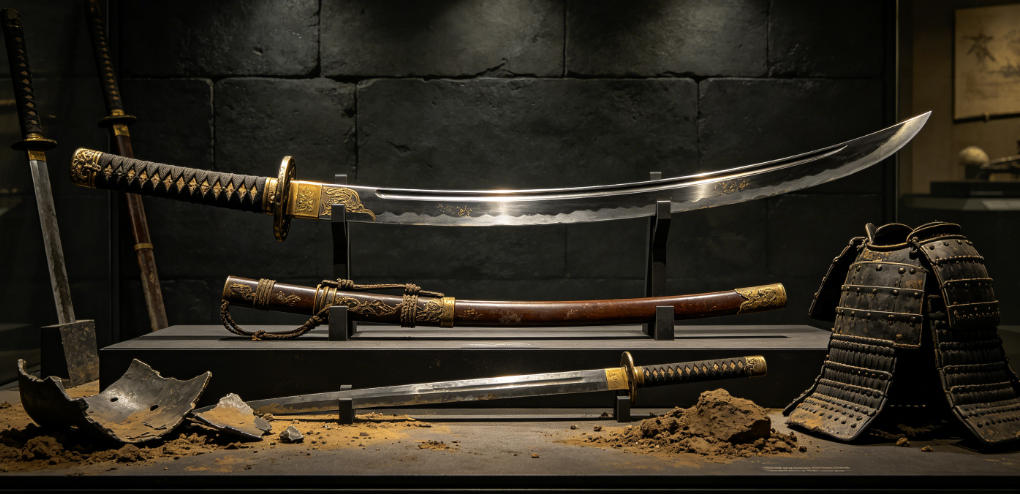
What Is a Nagamaki Sword and How Was This Samurai Weapon Used?
What Is a Nagamaki Sword?
The Nagamaki Sword (長巻) is one of the most unique weapons in Japanese sword history. Combining the characteristics of a traditional sword and a long-handled weapon, the Nagamaki features a curved single-edged blade similar to a katana or tachi, along with an unusually long handle wrapped in leather or cord.
Unlike the standard Katana, which has a shorter handle designed for close-range samurai combat, the Japanese Long Handled Sword known as Nagamaki provided greater reach and powerful sweeping attacks. Its design allowed warriors to generate strong cutting force while maintaining more control than a traditional polearm.
The name 'Nagamaki' means 'long wrapping,” referring to the extended handle wrapping style that resembles the grip construction of a Japanese sword rather than the simple wooden shaft of weapons like the Naginata.
Because of its unusual structure, the Nagamaki occupies a fascinating position in Japanese weapon history. It is often described as a weapon between a Katana and Naginata, combining the blade craftsmanship of a samurai sword with the reach of a battlefield pole weapon.
Today, the Nagamaki Sword remains popular among Japanese sword collectors, martial arts enthusiasts, and fans searching for unique samurai weapons and historical Japanese blades.
The Origins and History of the Nagamaki Sword
The history of the Nagamaki is closely connected with the development of large Japanese swords such as the Odachi (Ōdachi) and Nodachi.
During Japan’s medieval period, especially from the Kamakura period onward, warriors began using larger swords designed for battlefield situations where reach and cutting power were important. Some extremely long blades became difficult to handle with a normal sword grip, leading to the development of longer handles.
The Nagamaki is generally believed to have evolved from these oversized swords. Instead of simply extending the blade length, craftsmen created a longer grip that allowed warriors to control the weapon more effectively.
The weapon became especially associated with the Nanboku-chō period and later Sengoku Period, when Japan experienced constant warfare between competing samurai clans. During these eras, battlefield tactics changed rapidly, and weapons with greater range became increasingly valuable.
Unlike the elegant katana often associated with later samurai culture, the Nagamaki was primarily a practical battlefield weapon designed for reach, power, and versatility.

How Was the Nagamaki Designed?
The design of the Nagamaki Sword makes it different from almost every other Japanese sword.
A typical Nagamaki includes:
- A long curved single-edged blade
- A long handle (tsuka)
- Katana-style wrapping
- A Japanese sword-style tang
- A protective guard (tsuba)
- A large scabbard (saya)
The most recognizable feature is the unusually long handle, which could be close to the length of the blade itself. This gave the warrior more leverage and allowed powerful two-handed strikes.
The handle was often wrapped with leather or silk cord in a style similar to a katana grip. This provided a secure hold and improved control during combat.
Unlike a Naginata, which uses a blade mounted on a long wooden shaft, the Nagamaki maintained the construction style of a Japanese sword. The connection between blade and handle was closer to a sword than a traditional polearm.
This combination created a weapon with the cutting ability of a sword and the extended reach of a longer battlefield weapon.
Nagamaki vs Katana: What Is the Difference?
One of the most common questions about Japanese swords is:
'What is the difference between a Nagamaki and a Katana?'
Although both are traditional Japanese swords with curved single-edged blades, their designs and battlefield purposes were different.
Katana
The Katana became the iconic sword of the samurai class.
Its characteristics include:
- Curved blade
- Shorter handle
- Faster drawing technique
- Excellent close combat ability
- Designed for one or two-handed use
The katana was especially important during the later samurai era and became a symbol of warrior identity.
Nagamaki
The Nagamaki Sword focused more on reach and powerful sweeping movements.
Its characteristics include:
- Much longer handle
- Greater striking distance
- Strong cutting momentum
- Two-handed control
- Battlefield-oriented design
The Nagamaki allowed warriors to attack from farther away than a conventional sword while still maintaining the handling style of a Japanese blade.
In simple terms:
Katana = speed and close-range sword fighting
Nagamaki = reach and powerful battlefield strikes
Nagamaki vs Naginata: Is Nagamaki a Sword or Polearm?
Another popular comparison is Nagamaki vs Naginata.
Although these two weapons look similar, their construction is different.
The Naginata is a Japanese polearm consisting of a curved blade attached to a long shaft. It was widely used by samurai, warrior monks, and later associated with women warriors.
The Nagamaki, however, is closer to a sword.
The main differences include:
Nagamaki
- Sword-style handle
- Blade and tang construction similar to Japanese swords
- Long wrapped grip
- Designed for cutting and control
Naginata
- Long wooden shaft
- Polearm construction
- Greater emphasis on sweeping movements
- Often used against cavalry
Because of these differences, historians usually classify the Nagamaki as a unique Japanese sword type rather than simply another form of Naginata.
How Was the Nagamaki Used by Samurai Warriors?
The Nagamaki Samurai Weapon was designed for battlefield combat.
Its long handle allowed warriors to create powerful circular cuts while keeping enemies at a safer distance.
Common uses included:
- Fighting infantry formations
- Countering mounted opponents
- Delivering wide sweeping attacks
- Controlling battlefield space
The weapon was particularly effective when fighting in open areas where the user had enough room to utilize its large movements.
Because of its length, the Nagamaki required significant skill and strength. A warrior needed excellent control to manage the weapon’s momentum.
Unlike smaller swords designed for quick drawing and close fighting, the Nagamaki rewarded timing, distance management, and powerful technique.
Why Was the Nagamaki Effective Against Cavalry?
One reason long weapons became important in medieval Japan was their ability to challenge mounted warriors.
A normal sword required a soldier to get close to a mounted opponent. A longer weapon gave infantry a greater opportunity to attack while maintaining distance.
The Nagamaki Sword offered:
- Extended reach
- Powerful cutting ability
- Better control against moving targets
- Increased defensive distance
Although weapons such as spears and Naginata were also used against cavalry, the Nagamaki provided a sword-like experience with additional reach.
This made it a fascinating example of how Japanese warriors adapted weapons to changing battlefield conditions.
The Nagamaki During the Sengoku Period
The Sengoku Period (1467–1615) was one of the most important eras in Japanese warfare.
During this time, powerful daimyo fought for control of Japan, creating demand for effective battlefield weapons.
Large-scale infantry battles became more common, and samurai armies used many different weapons, including:
- Katana
- Yari (spears)
- Naginata
- Odachi
- Nagamaki
- Firearms
As battlefield formations became larger and more organized, some traditional long swords became less practical.
Spears eventually became dominant among many infantry units because they were easier to produce and use in large formations.
The Nagamaki gradually declined as warfare changed, but its historical importance remained.

Nagamaki and the Evolution of Japanese Long Swords
The Nagamaki represents an important stage in the evolution of Japanese sword design.
Its development shows how Japanese swordsmiths experimented with different combinations of:
- Blade length
- Handle design
- Combat range
- Balance
- Cutting power
It connects several famous Japanese weapons:
Tachi → Odachi → Nagamaki → Katana traditions
While these weapons were not simple replacements for one another, they demonstrate the continuous evolution of Japanese sword craftsmanship.
The Nagamaki reflects a period when samurai needed weapons capable of handling larger battlefields and changing combat styles.
How Was a Traditional Nagamaki Sword Made?
Like other Japanese swords, the Traditional Nagamaki Sword required advanced craftsmanship.
Swordsmiths focused on:
- Blade forging
- Steel selection
- Heat treatment
- Edge formation
- Curvature
- Balance
Traditional Japanese sword production often involved techniques such as folding steel and controlled tempering to create blades with both strength and sharpness.
The long handle also required careful construction because it needed to withstand powerful impacts.
A well-made Nagamaki was not simply a larger sword. It was a carefully balanced weapon where every part worked together.
Why Are Nagamaki Sword Replicas Popular Today?
Today, the Nagamaki Sword Replica has become popular among collectors, historical enthusiasts, and fans of Japanese culture.
Collectors appreciate Nagamaki because it represents a less common but highly distinctive part of samurai history.
Modern reproductions are often collected for:
- Home display
- Japanese sword collections
- Martial arts practice
- Historical decoration
- Anime and game inspiration
- Samurai culture appreciation
A handmade Nagamaki replica combines traditional Japanese aesthetics with the impressive size and unique design of this legendary weapon.
For collectors looking beyond standard katana, the Nagamaki offers a rare opportunity to own a piece inspired by Japan’s battlefield history.
Why Does the Nagamaki Sword Remain Fascinating Today?
The Nagamaki Sword represents the creativity and adaptability of Japanese weapon craftsmanship.
It was not simply a longer katana or a shorter polearm. Instead, it created its own category by combining sword construction with extended reach.
From medieval samurai battles to modern collections, the Nagamaki continues to attract attention because of its:
- Unique design
- Historical background
- Connection to samurai warriors
- Relationship with Katana, Naginata, and Odachi
- Impressive craftsmanship
For anyone interested in Japanese sword history, traditional samurai weapons, or rare Japanese swords, the Nagamaki remains one of the most remarkable weapons ever created in Japan.
