William Wallace Sword: History, Claymore Facts and Braveheart Legend
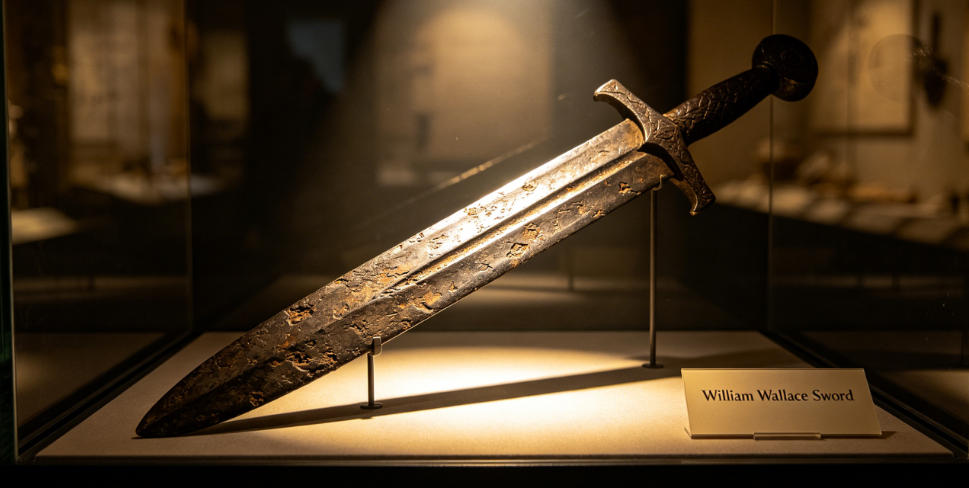
Was the William Wallace Sword Really a Claymore Used by Braveheart?
Is the William Wallace Sword Real? History, Design, and Origins Explained
Few medieval weapons are as closely associated with Scottish history as the William Wallace Sword. Linked through tradition to William Wallace, the Scottish military leader of the Wars of Scottish Independence, this enormous two-handed sword has become an enduring symbol of Scotland, medieval warfare, and resistance.
The sword is also widely known because of Braveheart, the 1995 historical drama that introduced William Wallace and his oversized sword to a global audience. However, the cinematic image and the surviving historical artifact are not exactly the same.
The sword preserved at the National Wallace Monument in Stirling is approximately 1.68 meters long and weighs around 3 kilograms. It is traditionally associated with William Wallace, but there is no surviving contemporary evidence that conclusively proves the sword on display was personally used by him. The weapon was first recorded at Dumbarton Castle in 1505, centuries after Wallace's death.
This combination of history, legend, archaeology, and popular culture makes the William Wallace sword history especially fascinating for anyone interested in medieval swords.
Who Was William Wallace?
William Wallace was one of the most famous Scottish leaders during the First War of Scottish Independence against the forces of Edward I of England.
His historical career is strongly connected with the Battle of Stirling Bridge in 1297, where Scottish forces led by Wallace and Andrew de Moray defeated a larger English army. The narrow wooden bridge across the River Forth played an important role in the battle because it limited the number of English troops able to cross at one time.
After the victory, Wallace was knighted and became Guardian of Scotland. His later military career included the Scottish defeat at Falkirk in 1298. Wallace was eventually captured in 1305 and executed.
His life became increasingly legendary over the centuries, and his image evolved from a medieval military leader into one of the most recognizable figures in Scottish historical memory.

What Is the Wallace Sword?
The sword commonly called the Wallace Sword is a very large medieval-style two-handed sword currently preserved at the National Wallace Monument in Stirling.
According to the monument, the weapon measures about 1.68 meters and weighs approximately 3 kilograms. It was first documented at Dumbarton Castle in 1505 and was transferred to the National Wallace Monument in 1888.
The traditional story connects the sword with William Wallace, but its exact provenance remains difficult to establish.
This distinction is important when researching the Braveheart sword real weapon question. The sword is unquestionably a historic object and an important Scottish cultural artifact, but that does not automatically prove that it was Wallace's personal battlefield sword.
Rather than separating the object from the legend, its history is best understood as a combination of documented evidence, historical tradition, and later cultural interpretation.
Is the William Wallace Sword a Claymore?
One of the most common questions about the William Wallace sword is whether it was a Claymore sword.
The answer depends on how the word “claymore” is being used.
In modern popular culture, claymore is frequently used as a general term for a large Scottish two-handed sword. However, historical Scottish sword terminology is more complicated, and the classic two-handed claymore is generally associated with later medieval and early modern Scottish weapon development.
The Wallace Sword is therefore often discussed alongside the Scottish claymore sword, but it should not automatically be treated as a perfectly standardized example of the later classic claymore.
This distinction matters because medieval sword designs changed considerably over time.
William Wallace Sword vs Classic Claymore
The relationship between the William Wallace Sword and the claymore tradition can be understood through their general characteristics.
William Wallace Sword
The surviving sword is:
-
Extremely long
-
Designed for two-handed use
-
Associated with Scottish medieval history
-
Preserved at the National Wallace Monument
-
Traditionally connected with William Wallace
Classic Two-Handed Claymore
Later Scottish two-handed swords are generally recognized by their long blades, large grips, and distinctive crossguards, with some examples featuring characteristic downward-sloping guard arms.
Because sword terminology developed over centuries, calling every large Scottish sword a “claymore” can oversimplify the historical record.
For collectors searching for Scottish claymore sword origin, understanding this chronological difference provides a more accurate picture of Scottish sword evolution.
How Was a Medieval Two-Handed Sword Designed?
Large medieval swords were not simply oversized versions of ordinary one-handed swords.
A medieval two handed sword required a longer grip that allowed both hands to control the weapon. The extended handle increased leverage and gave the wielder greater control over a large blade.
The long blade also provided considerable reach.
Depending on the specific sword type and period, a large two-handed sword could be used for powerful cuts as well as controlled thrusting. Its effectiveness depended on the weapon's balance, blade geometry, grip, and the training of the person using it.
The exact handling characteristics of the surviving Wallace Sword should not be assumed to represent every Scottish greatsword, because medieval swords varied substantially in construction and purpose.
What Was the Purpose of Large Scottish Greatswords?
Large swords had practical battlefield applications, but their exact tactical roles varied according to period, weapon design, and battlefield conditions.
In medieval Scotland, infantry formations could use long spears and other polearms to create dense defensive formations. At Stirling Bridge, Scottish forces used tightly packed spear formations known as schiltrons.
A large sword provided reach and cutting power, but it was only one component of medieval warfare.
Medieval soldiers also relied on:
-
Spears
-
Polearms
-
Bows
-
Shields
-
One-handed swords
-
Daggers
-
Armor
-
Horses
The idea that a huge sword was designed exclusively to “break formations” is therefore an oversimplification. Its battlefield usefulness depended on the circumstances and the wider military system in which it was used.
What Did Scottish Warriors Use at Stirling Bridge?
The Battle of Stirling Bridge took place on September 11, 1297.
According to the National Wallace Monument, the English army had to cross a narrow wooden bridge over the River Forth. Wallace and Moray positioned their forces on the north side and waited until a substantial portion of the English army had crossed before launching their attack.
Scottish infantry relied heavily on long spears and formations known as schiltrons.
This is an important part of understanding medieval Scottish weapons. Medieval battles were rarely decided by a single famous sword. Spears, formations, terrain, cavalry, archers, armor, and command decisions all played important roles.
The Wallace Sword became famous later because it provided a tangible object through which people could remember Wallace and the struggle for Scottish independence.
Did William Wallace Really Use the Wallace Sword?
This remains one of the most interesting questions surrounding the weapon.
The National Wallace Monument describes the sword as traditionally associated with Wallace and notes that it was first recorded at Dumbarton Castle in 1505. The surviving documentation therefore comes from a period well after Wallace's death in 1305.
Because there is no surviving contemporary record conclusively identifying the present sword as Wallace's personal weapon, the attribution should be treated as traditional rather than absolutely proven.
This does not make the sword unimportant.
Its historical significance comes from its long association with Wallace, Scotland, and the memory of the Wars of Scottish Independence.
The difference between 'historically proven to have belonged to Wallace' and 'traditionally identified as Wallace's sword' is essential when discussing the true William Wallace sword.

The Wallace Sword at the National Wallace Monument
The sword has been displayed at the National Wallace Monument since 1888.
Its journey to the monument itself became part of its modern history. The weapon had previously been held at Dumbarton Castle, and efforts were made during the 19th century to preserve and display it as an important symbol of Scottish history.
The sword has also experienced dramatic events in modern times. It was stolen from the monument in 1936 and again in 1972 before being recovered on both occasions. In 2023, the sword returned to display after being temporarily removed for security reasons.
Today, it remains one of the most recognizable objects associated with William Wallace.
How Did Braveheart Change the Image of the Wallace Sword?
The movie Braveheart played a major role in transforming William Wallace into a global pop-culture icon.
Released in 1995, the film presented Wallace as a larger-than-life Scottish freedom fighter and gave audiences around the world a dramatic image of medieval Scotland.
The sword shown in the film is also visually different from the surviving Wallace Sword in important ways. Its exaggerated proportions were designed for cinematic impact rather than as a precise museum reconstruction.
This distinction is important for anyone searching for Braveheart sword facts or asking whether the weapon shown in the film was historically accurate.
Movies can introduce historical subjects to enormous audiences, but costume design, weapon dimensions, battle scenes, and character portrayals are often adapted for storytelling.
Wallace Sword vs Braveheart Sword
The difference can be summarized simply.
The historical Wallace Sword is a real surviving medieval-style weapon preserved at the National Wallace Monument.
The Braveheart sword is a cinematic representation created for a modern film.
The two are connected through the character of William Wallace, but they should not be treated as identical historical objects.
The popularity of Braveheart nevertheless helped increase worldwide interest in Scottish history, medieval swords, Claymore swords, and historical sword collecting.
What Makes a Scottish Greatsword Different?
A Scottish greatsword was part of a broader European tradition of large two-handed swords.
Across Europe, long two-handed weapons developed in response to changing military environments. Their designs differed according to regional traditions, fighting methods, armor, and manufacturing techniques.
Scottish examples are particularly recognizable because of their association with Highland culture and later claymore traditions.
The Scottish claymore sword therefore represents more than a single design. It is part of a much larger history of Scottish sword development.
When studying historical swords, it is useful to consider:
-
Blade length
-
Grip construction
-
Crossguard shape
-
Blade profile
-
Point geometry
-
Balance
-
Historical period
-
Regional origin
These characteristics help distinguish one sword type from another.
Why Is the William Wallace Sword Still Famous Today?
The continued popularity of the William Wallace Sword comes from the unusual combination of history and legend surrounding it.
It connects several layers of Scottish cultural history:
-
William Wallace
-
The Wars of Scottish Independence
-
The Battle of Stirling Bridge
-
Medieval Scottish warfare
-
Scottish greatswords
-
The claymore tradition
-
The National Wallace Monument
-
The movie Braveheart
The sword therefore has meaning beyond its physical construction.
For historians, it raises questions about provenance and medieval sword development. For collectors, it represents the appeal of historical European swords. For popular culture, it has become an instantly recognizable symbol of William Wallace.
Why Do Collectors Like William Wallace Sword Replicas?
Modern historical greatsword reproduction swords allow enthusiasts to explore the appearance and proportions of famous medieval weapons without owning rare museum artifacts.
A William Wallace sword replica may be created for:
-
Historical display
-
Medieval collections
-
Scottish heritage decoration
-
Film-inspired collections
-
Reenactment
-
Historical study
-
Sword collecting
Collectors should distinguish between a historically inspired reproduction and an archaeological original.
A reproduction can faithfully recreate the appearance of a famous weapon while still being a modern product. The value lies in craftsmanship, historical inspiration, materials, construction, and presentation.
The Legacy of William Wallace and His Sword
The story of William Wallace demonstrates how historical objects can become symbols far beyond their original practical purpose.
The surviving Wallace Sword may not provide every answer about Wallace's personal battlefield equipment, but its long association with him has made it one of Scotland's most famous swords.
From the medieval battlefields of the Scottish Wars of Independence to the modern National Wallace Monument and the global popularity of Braveheart, the weapon has traveled through centuries of historical memory.
Whether you are researching William Wallace sword history, the Scottish claymore sword origin, medieval two handed sword facts, or the question “Was the Braveheart sword real?”, the most fascinating part of the story is the meeting point between documented history and enduring legend.
The Wallace Sword is therefore best understood not simply as a weapon, but as a historic artifact whose cultural meaning has grown through centuries of storytelling, preservation, and public memory.
