Jambiya Knife: History, Meaning & Traditional Yemeni Dagger
What Is a Jambiya Knife and What Does This Yemeni Dagger Mean?
What Is a Jambiya Knife and Why Is This Curved Dagger Important?
Among the world's traditional weapons, few are as visually distinctive and culturally meaningful as the jambiya knife. Also spelled janbiya, jambya, jambia, or janbia, the jambiya is a traditional curved dagger strongly associated with Yemen and the Arabian Peninsula. Unlike an ordinary knife or combat dagger, the jambiya combines blade design, traditional craftsmanship, clothing, social identity, and cultural heritage in a single object.
The Yemeni jambiya is especially recognizable for its short, strongly curved blade, decorated handle, ornate sheath, and wide belt worn around the waist. Historical examples show that the dagger was not simply carried as a weapon. In Yemen, the way a jambiya was made, decorated, and worn could communicate information about the wearer's identity, family background, age, and social position.
Today, searches for terms such as jambiya knife history, jambiya dagger history, Yemeni dagger, Arabian dagger, curved dagger Middle East, and jambiya meaning reflect growing interest in traditional weapons, Middle Eastern history, and collectible blades.
What Is a Jambiya Knife?
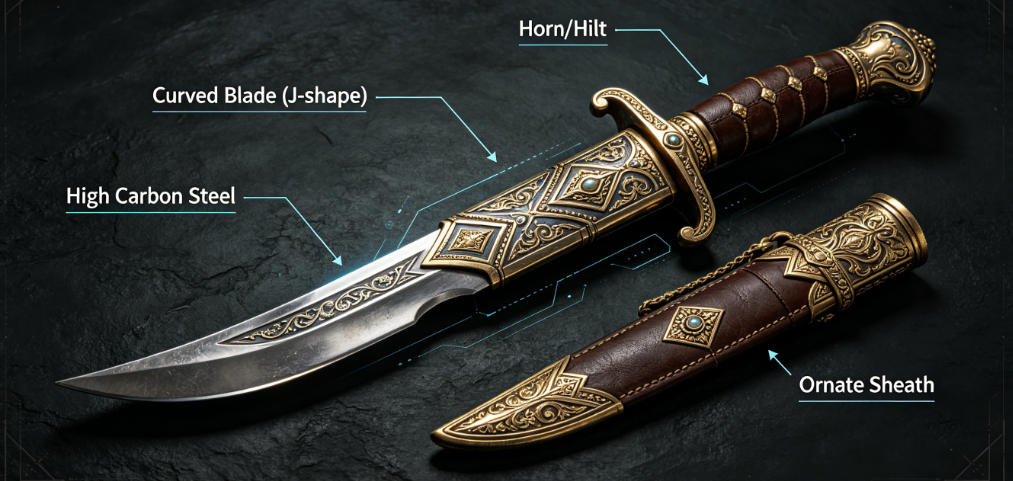
A jambiya knife is a short, curved, generally double-edged dagger traditionally associated with the Arabian Peninsula. The classic Yemeni form has a pronounced curved profile, often resembling a broad J-shape when viewed together with its sheath. A central ridge or medial rib is also a characteristic feature of many traditional jambiya blades.
The name is connected with the Arabic concept of the side of the body, reflecting its traditional method of wearing the dagger. Interestingly, although the name suggests a side-worn blade, traditional Yemeni examples were commonly worn toward the front of the body beneath or over traditional clothing.
The main components of a traditional jambiya include the blade, hilt, scabbard, and belt. The blade is usually compact, while the handle and sheath can receive extensive decorative treatment. Silverwork, engraved metal, leather, horn, hardwood, and other materials may be incorporated depending on the region, period, and status associated with the dagger.
This combination makes the jambiya different from a purely utilitarian curved knife. Its physical form and decoration developed together with the cultural traditions surrounding it.

Curved Dagger Design: Why Does the Jambiya Have a Curved Blade?
The curved blade is the defining characteristic of the jambiya. Unlike a straight dagger, its blade follows a pronounced inward curve, creating a distinctive silhouette that is immediately recognizable.
From a historical perspective, this geometry reflects both functional requirements and regional blade-making traditions. The curved profile can support cutting and close-range movements while allowing the dagger to remain compact when worn at the waist.
Traditional Yemeni jambiya blades commonly feature a strong central ridge that gives the blade a distinctive appearance and contributes to its structural character. Museum and ethnographic records describe traditional Yemeni examples as broad near the hilt, tapering toward the point, with a prominent medial ridge extending along the blade.
1. Distinctive Curved Blade Geometry
The most recognizable feature of the curved dagger is its blade shape. Rather than following a straight centerline, the jambiya curves inward toward the point.
This creates several recognizable characteristics:
-
A compact but highly distinctive blade profile
-
A strong visual connection between blade and scabbard
-
A geometry associated with traditional Arabian dagger design
-
A shape suitable for close-range historical use
-
A silhouette that separates the jambiya from straight European or Asian daggers
The curve is therefore both a functional element and an important part of the dagger's cultural identity.
2. Central Ridge and Blade Construction
Many traditional Yemeni jambiyas have a pronounced central ridge or medial rib. Historical examples can show different ridge configurations, including older blades with multiple ribs and recessed areas between them.
For collectors interested in traditional dagger craftsmanship, these details are particularly important because blade geometry can help distinguish regional styles, historical examples, and modern decorative reproductions.
3. Hilt, Scabbard, and Belt
The jambiya is designed as a complete wearable system rather than simply a loose blade.
A traditional set may include:
-
A decorated hilt
-
A curved double-edged blade
-
A fitted scabbard
-
A leather or textile belt
-
Silver or metal decorative elements
-
Engraving, geometric ornament, or inlay
The scabbard is especially important because its shape often follows the dramatic curve of the blade. Decorative metalwork can transform the sheath into an important part of the overall visual design.
Jambiya History: Where Did the Yemeni Dagger Come From?
The jambiya history is closely connected to Yemen and the southern Arabian Peninsula. Yemen is widely regarded as one of the central cultural regions for the traditional jambiya, although related dagger traditions spread throughout the Arabian Peninsula and beyond.
Historical research has documented jambiya wearing in Yemen and other areas influenced by Arabian culture. The dagger also traveled through trade, migration, and cultural exchange, contributing to regional variations in blade shape, handles, and scabbards.
The broader history of the Arabian dagger reflects the movement of people and goods across the Red Sea, Arabian Peninsula, Persian Gulf, and Indian Ocean. As a result, related curved dagger traditions can be found in neighboring regions, although they should not automatically be treated as identical to the Yemeni jambiya.
Regional Styles of the Jambiya Knife
Although the term jambiya is often used broadly, traditional daggers from different regions can have noticeably different designs.
1. Yemeni Jambiya
The Yemeni jambiya is perhaps the best-known form of the traditional Arabian dagger.
Typical characteristics include:
-
Strongly curved blade
-
Broad blade base and tapered point
-
Central medial ridge
-
Decorated horn, wood, or other traditional handles
-
Curved scabbard
-
Leather or textile belt
-
Silver and metal ornamentation
In Yemen, the jambiya has historically functioned as an important marker of identity and social status rather than simply a weapon. Ethnographic research has documented its association with manhood, status, dress, ceremonies, and traditional social customs.
2. Omani Khanjar
The Omani khanjar is a closely related Arabian dagger that shares some visual characteristics with the jambiya, particularly its curved blade and ornate sheath.
However, the khanjar developed its own distinctive regional traditions, so it is more accurate to describe it as a related dagger form rather than simply another name for the Yemeni jambiya.
3. Gulf Arabian Daggers
Across Saudi Arabia and other Gulf regions, curved daggers have also appeared as elements of traditional dress and ceremonial culture. Their materials, proportions, hilts, and scabbards can vary significantly according to local traditions.
4. Indian Ocean and East African Connections
Trade across the Red Sea and Indian Ocean helped circulate Arabian weapons, crafts, and design influences. This created opportunities for related dagger forms and decorative traditions to appear outside the Arabian Peninsula.
What Does a Jambiya Mean?
One of the most interesting aspects of the jambiya is its cultural meaning.
In traditional Yemeni society, the jambiya can represent much more than a weapon. It can communicate:
-
Adulthood
-
Masculine identity
-
Family heritage
-
Social standing
-
Cultural belonging
-
Traditional dress
-
Ceremonial identity
Historical accounts describe the jambiya as an important part of men's traditional clothing in Yemen. The dagger could be worn during ordinary life as well as during social and ceremonial occasions.
This is why the jambiya meaning cannot be understood simply by looking at its blade. Its belt, handle, scabbard, decoration, and manner of wearing are all part of the cultural system surrounding it.
Jambiya Craftsmanship and Traditional Materials
Traditional jambiya craftsmanship combines metalworking, blade forging, leatherwork, wood or horn carving, and decorative arts.
Commonly encountered materials include:
-
Carbon steel
-
Hand-forged steel
-
Traditional steel blades
-
Damascus-pattern steel in modern reproductions
-
Hardwood
-
Horn
-
Leather
-
Silver
-
Copper and other decorative metals
The handle is particularly significant in many traditional examples. Elaborately decorated hilts and scabbards can require considerable skill from specialized artisans.
Historical examples documented by the University of Pennsylvania Museum describe horn handles, steel blades, silver decoration, engraved metalwork, granulation, and regionally distinctive sheath designs.
For modern collectors searching for a hand forged jambiya, Damascus jambiya, or traditional Yemeni dagger, craftsmanship and materials are therefore important factors when evaluating an example.

Jambiya vs Other Curved Daggers
The jambiya belongs to the broader family of curved daggers, but it has a distinctive cultural identity.
A generic curved dagger may refer simply to a blade with a curved profile. A jambiya, by contrast, refers to a particular traditional dagger tradition associated especially with Yemen and the Arabian Peninsula.
Its identity comes from the complete combination of:
-
Curved blade geometry
-
Characteristic hilt design
-
Fitted curved scabbard
-
Waist belt
-
Traditional clothing
-
Regional craftsmanship
-
Cultural symbolism
This distinction is useful when researching Middle Eastern daggers, Arabian daggers, and traditional weapons from different regions.
Why Is the Jambiya Still Important Today?
Although its historical practical role differs from its modern cultural role, the jambiya remains an important symbol of Yemeni heritage.
Modern interest in the dagger can be divided into several areas:
Historical research: Collectors and historians study jambiyas to understand Arabian weapons, craftsmanship, clothing, and social traditions.
Cultural heritage: The dagger remains closely connected with traditional Yemeni identity and ceremonial dress.
Craftsmanship: Handmade handles, silver decoration, leatherwork, and blade forging attract people interested in traditional crafts.
Collecting: Historical and reproduction examples appeal to collectors of traditional daggers, Middle Eastern weapons, and ethnographic objects.
This transformation—from practical dagger to cultural artifact—is one of the most fascinating aspects of jambiya knife history.
How to Recognize a Traditional Jambiya
When researching a jambiya, several design features can help identify the traditional form:
-
Curved blade: The blade usually has a pronounced inward curve.
-
Central ridge: Many Yemeni examples feature a strong medial ridge.
-
Distinctive hilt: Traditional handles can use horn, hardwood, or other materials.
-
Curved scabbard: The sheath follows the characteristic blade profile.
-
Decorative belt: The dagger is traditionally worn with a dedicated belt system.
-
Regional decoration: Silverwork, engraving, geometric patterns, and other details can indicate regional craftsmanship.
Collectors should also distinguish historical examples from modern decorative replicas, since contemporary reproductions may combine traditional motifs with modern materials or manufacturing methods.
Jambiya Knife as a Symbol of Arabian Heritage
The enduring appeal of the jambiya knife comes from the fact that it represents several layers of history at once.
It is a blade, but it is also traditional clothing. It is a piece of craftsmanship, but it is also a symbol of identity. It has a history connected to personal defense and close-range combat, yet its cultural importance extends far beyond its original practical function.
From the traditional Yemeni dagger to related Arabian curved daggers, the jambiya provides a fascinating example of how weapons can become cultural artifacts. Its distinctive blade, decorated hilt, curved scabbard, and traditional belt form a visual language that remains recognizable today.
Conclusion
The jambiya knife is one of the world's most distinctive traditional daggers. Its curved blade, central ridge, ornate hilt, decorated scabbard, and traditional belt create a design unlike most other historical weapons.
More importantly, the Yemeni jambiya demonstrates how a weapon can evolve into a powerful cultural symbol. Its history connects traditional blade forging, Arabian clothing, family heritage, craftsmanship, social identity, and modern collecting culture.
Whether you are researching jambiya dagger history, exploring Arabic dagger meaning, comparing Middle Eastern daggers, or studying traditional curved dagger craftsmanship, the jambiya offers a unique window into the history and cultural heritage of the Arabian Peninsula.
