Leviathan Axe Explained: God of War Lore, Meaning & Combat Guide
- von liqinliqin
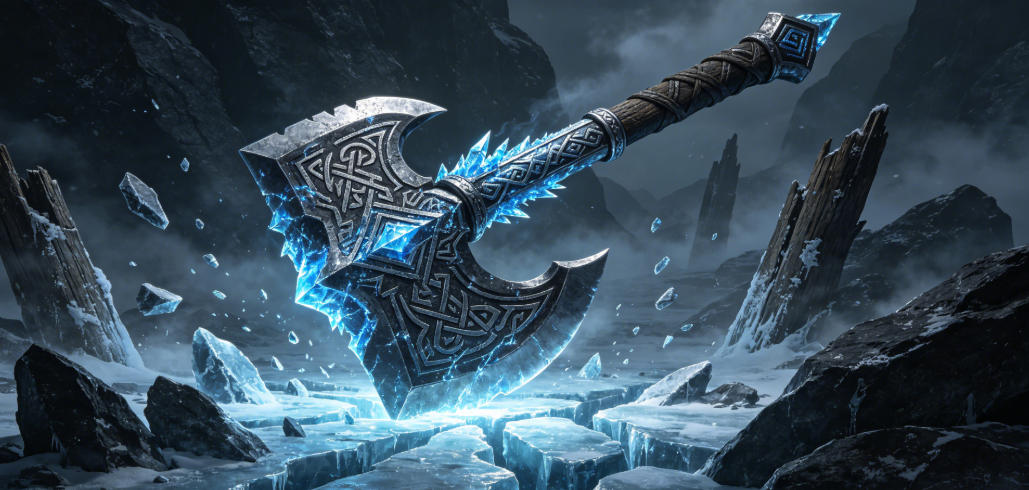
Why is the Leviathan Axe so important in God of War and what does it represent?
In the Norse chapter of God of War, Kratos undergoes a fundamental transformation in both life and combat style. At the center of this shift lies the seemingly heavy yet elegantly controlled frost-forged weapon—the Leviathan Axe.
It is not merely a weapon, but an extension of Kratos’ identity after becoming a father. Whether players encounter it under its official name or various search terms, it ultimately points to one fact: he is no longer the destroyer driven solely by rage.
I. A Symbol of the New Norse Era
The creation of the Leviathan Axe is not just a gameplay replacement—it represents a core shift in the worldbuilding of the Norse saga.
It was forged by the dwarven blacksmiths Sindri and Brok, and from the beginning, it was designed as more than a weapon. It is a strategic artifact intended to balance the overwhelming power gap between gods.
Within Norse mythology, Thor’s lightning represents an almost unavoidable, oppressive force. The design philosophy of the axe was therefore clear: not to maximize destructive chaos, but to establish a controlled system of divine-level power output.
In other words, its core value is not 'more power,' but 'controlled power.'
Because of this philosophy, the Leviathan Axe embodies order from its very conception. Unlike Kratos’ past weapons that emphasize uncontrolled explosive rage, this one emphasizes rhythm, precision, and disciplined execution.
More importantly, it redefines Kratos’ combat identity. He is no longer a rage-driven destroyer acting on instinct, but a tactical executor who fights with calculation and restraint.
As a result, combat shifts from continuous aggression to decision-based strikes where every hit matters.
Thus, the Leviathan Axe becomes one of the most iconic symbols of Kratos’ evolution—from chaos to control.

Was the Leviathan Axe real?
No, the Leviathan Axe is not a real historical weapon.
It was created specifically for the 2018 video game God of War by Santa Monica Studio. In the game, it is wielded by Kratos as a magical Norse-inspired axe that can be thrown and magically recalled, similar to Thor’s hammer, Mjölnir.
Why it feels real
Despite being fictional, it feels authentic because it draws inspiration from real-world Viking aesthetics:
- Based on Viking bearded axe designs
- Runic and mythological engravings
- A realistic combination of metal head and wooden haft
- Balanced throwing mechanics (though exaggerated for gameplay)
II. How Ice Power Changes Combat Logic
The most fundamental impact of the Leviathan Axe is that it completely reshapes combat rhythm in God of War.
If the Blades of Chaos represent 'speed and emotional release,' the Leviathan Axe represents the opposite: control, timing, and tactical decision-making.
Its frost-based mechanics redefine combat in three key ways:
1. Freeze and Control: From Damage to Battlefield Management
The most immediate effect of frost power is direct enemy control.
Hits can slow, stagger, or even freeze enemies, transforming combat structure:
- Enemies become manageable targets rather than constant threats
- Players can prioritize targets strategically
- Group fights become segmented into controllable moments
This shifts Kratos from reacting to chaos into actively shaping the battlefield.
Combat becomes less about chaos and more like a structured rhythm system.
2. Throw-and-Recall: Expanding Combat Space
One of the axe’s defining mechanics is its ranged throw and magical recall system.
Its significance goes beyond ranged attacks:
- Initiates combat from long range
- Creates high-impact damage windows
- Recall path itself deals damage
- Enables rapid switching between range and melee
This transforms combat from a flat close-range system into a fully spatial battlefield experience.
Players are no longer locked into distance constraints—they constantly manipulate space and timing.
The throw-recall loop also creates a unique combat rhythm, where each action feels like part of a structured sequence rather than isolated attacks.
3. Weight and Feedback: Every Strike Has Meaning
Beyond mechanics, the axe fundamentally changes combat feel.
Compared to faster weapons, it is slower but significantly heavier in impact:
- Strong vibration and sound feedback on hit
- Slower animations but more grounded impact
- Each strike feels intentional rather than automatic
This naturally changes player behavior:
Instead of spamming combos, players begin to think:
“Is this strike worth it?”
Combat evolves from execution to decision-making under risk and reward.
III. Why Kratos Chooses Ice Instead of Fire
A natural question arises: why abandon fire-based chained weapons for ice-based combat?
The answer lies in Kratos’ character evolution.
The old weapons represent:
- An inescapable past
- Uncontrolled rage
- A cycle of destruction
The new weapon represents:
- Emotional restraint
- Controlled behavior
- Responsibility as a father
Thus, the frost axe is not just a weapon—it is a cooling system for Kratos’ psyche, shifting him from volatility to stability.

IV. Secrets of Dwarven Forging and Rune Systems
The creation of the axe is tied to legendary dwarven craftsmanship.
Sindri designed the precise rune structure, while Brok handled physical forging and energy stability. Together, they created a weapon with extremely high magical stability.
Most importantly, it carries a critical narrative property:
It is capable of directly opposing the power of Thor.
This elevates it beyond a 'powerful weapon' into one that can stand against god-tier forces in the Norse pantheon.
V. Why the Combat System Is So Addictive
The weapon is deeply integrated into gameplay design rather than being a cosmetic upgrade.
It enables seamless transitions between:
- Close-range heavy melee pressure
- Long-range precision throwing
- Recall-based secondary damage
Combined with frost mechanics, combat becomes strategic rather than purely fast-paced.
Additionally, every strike carries significant weight and feedback, making each action satisfying and meaningful.
VI. Two Weapons, Two Lives
A clear contrast emerges between two combat philosophies:
The Blades of Chaos represent the past—rage, destruction, and an endless cycle of violence.
The Leviathan Axe represents the present—a controlled, stable, and responsible way of fighting.
This transformation reflects Kratos not just as a warrior, but as a father attempting to control his destiny.
VII. Why It Became an Iconic Weapon
The Leviathan Axe is widely discussed not simply because it is powerful, but because it tells a story.
It integrates character development, combat design, and worldbuilding into one unified symbol:
- Highly recognizable visual identity
- Deeply satisfying combat feedback
- Strong narrative symbolism
It is not just a weapon—it is a storytelling device embedded into gameplay.
One-Line Summary
The Leviathan Axe is more than a frost weapon—it is the turning point of Kratos’ transformation from destroyer to protector, embodying the fusion of power and restraint in a single divine artifact.
