Roman Spatha Sword: History, Design and Spatha vs Gladius
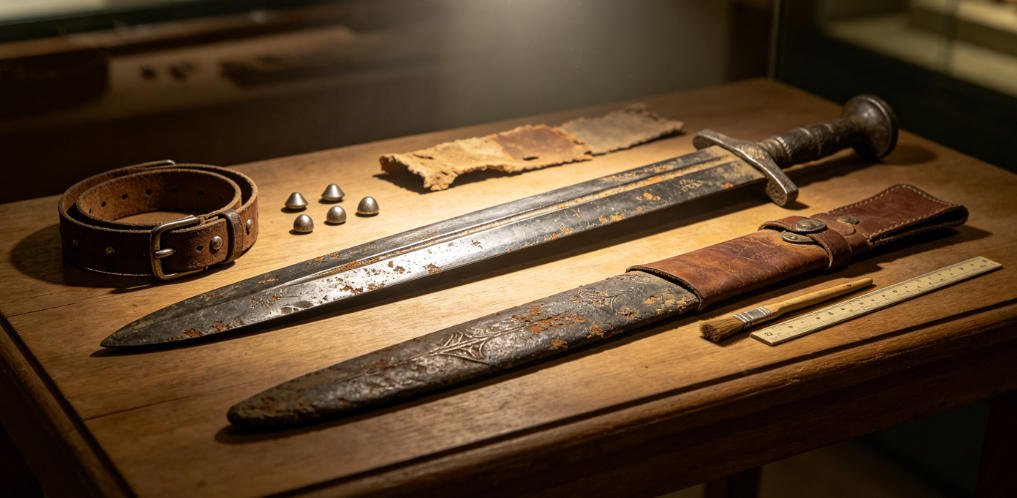
Why Did Rome Replace the Gladius With the Longer Spatha Sword?
What Was the Roman Spatha Sword?
The Roman Spatha Sword was one of the most important long-bladed weapons in the later history of the Roman army. Often described as a Roman longsword, the spatha became increasingly common from the Imperial period onward and eventually replaced the shorter gladius as the principal sword carried by many Roman soldiers.
The transition from gladius to spatha was not simply a matter of making the Roman sword longer. It reflected broader changes in Roman warfare, including the growing importance of cavalry, frontier conflicts, more mobile combat, and changing military equipment.
The classic Roman Gladius was closely associated with the heavily organized infantry formations of the early Empire. Its relatively short blade was particularly useful in close quarters, where soldiers could advance behind the large scutum shield and deliver controlled thrusts.
The Spatha, by comparison, provided greater reach while retaining the ability to thrust. Many examples also supported effective cutting attacks, making the weapon adaptable to different combat environments.
Archaeological and historical evidence shows that the spatha had already been used by auxiliary troops and cavalry before becoming widespread among infantry. By the later Roman period, the longer sword had become an important part of Roman military equipment.
Where Did the Spatha Come From?
The origins of the Roman Spatha are connected with longer European swords that existed outside the traditional Roman military system.
Rome constantly interacted with neighboring peoples through warfare, diplomacy, trade, and military recruitment. Celtic and Germanic warriors used a variety of longer swords, and Roman forces encountered these weapons on different frontiers.
The Romans were particularly skilled at adapting useful technologies from other cultures. Instead of remaining dependent on one standardized weapon, Roman military equipment evolved as battlefield requirements changed.
The spatha became especially associated with auxiliary cavalry. A longer blade was useful for mounted soldiers because it increased the distance at which a rider could reach an opponent.
This made the Roman cavalry sword an important stage in the development of the spatha. Over time, the weapon moved beyond its earlier specialist role and became increasingly common among other branches of the Roman military.
The story of the spatha therefore demonstrates one of the most important characteristics of Roman military history: Rome frequently transformed foreign influences into standardized military equipment.

Roman Spatha vs Gladius: What Was the Difference?
The comparison between spatha vs gladius is one of the most popular subjects in ancient Roman weapons history.
The two swords were not simply different lengths of the same weapon. Their development was connected with different battlefield requirements.
Roman Gladius
The gladius was a relatively short sword strongly associated with Roman legionary infantry during the Republic and early Empire.
Its characteristics included:
-
Compact blade
-
Strong point
-
Excellent thrusting capability
-
Easy handling in close formation
-
Compatibility with the scutum
-
Effective use at very short range
The Roman legionary could protect himself with the shield while using the sword to make short, controlled thrusts.
This fighting system worked particularly well when Roman infantry operated in disciplined formations.
Roman Spatha
The spatha featured a substantially longer blade and offered greater reach.
Typical characteristics included:
-
Longer double-edged blade
-
Greater reach
-
Strong cutting capability
-
Continued thrusting ability
-
Suitability for cavalry
-
Adaptability to more open combat
A commonly cited median blade length for the spatha is around 760 mm, compared with roughly 460 mm for the gladius, although archaeological examples varied considerably.
The difference was therefore more than simply “short sword versus long sword.” It reflected changing military environments.
Why Did the Roman Army Replace the Gladius With the Spatha?
The question “Why did Rome replace the gladius with the spatha?” does not have one simple answer.
The change developed gradually and probably resulted from several overlapping factors.
1. Greater Reach
The most obvious advantage of the spatha was its longer blade.
In situations where soldiers were not locked into extremely tight formations, additional reach could provide more opportunities to strike an opponent before coming within close range.
For mounted soldiers, this advantage was even more obvious.
2. Growing Importance of Cavalry
Roman warfare changed considerably during the later Empire.
Cavalry became increasingly important for reconnaissance, rapid attacks, pursuit, frontier warfare, and maneuver.
A short gladius was practical for close infantry combat, but a longer Roman cavalry sword offered a more useful reach from horseback.
The spatha therefore became closely associated with mounted warfare before eventually spreading more widely.
3. More Mobile Battlefield Conditions
The Roman army did not fight every enemy using the same formation or battlefield strategy.
Rome fought across an enormous geographical area, from Britain and the Rhine frontier to the Balkans, North Africa, and the eastern Mediterranean.
Different opponents used different combinations of cavalry, infantry, missiles, shields, and long weapons.
A longer sword provided greater versatility in these changing environments.
4. Evolution of Roman Military Organization
The Roman military itself changed over time.
The highly standardized image of the early Imperial legion became less representative of the increasingly diverse military structure of the later Empire.
Auxiliaries, cavalry, specialized troops, and regional forces played increasingly important roles.
The Roman Spatha Sword fit naturally into this more diversified military environment.
How Was the Spatha Used in Battle?
The Roman spatha was not exclusively a slashing weapon.
Although its longer blade gave it greater potential for cutting attacks, it retained a point and could be used for thrusting.
This combination made it a flexible weapon.
A trained soldier could use the sword for:
-
Thrusting
-
Cutting
-
Defensive movements
-
Attacks against exposed targets
-
Mounted combat
-
Close infantry fighting
The British Museum notes that the spatha is generally associated with the long Celtic sword tradition and that Roman military writers continued to emphasize thrusting techniques. This reminds us that it would be misleading to divide Roman swords into 'gladius = thrusting' and 'spatha = cutting' as if each had only one function.
The exact balance between cutting and thrusting depended on the individual blade and the way it was used.
Why Was the Spatha Ideal for Roman Cavalry?
The connection between spatha and Roman cavalry is one of the most important parts of its history.
Mounted combat creates different requirements from infantry combat.
A rider moves rapidly past an opponent, which makes reach extremely important. A longer blade can extend the effective striking distance without requiring the rider to lean dangerously far from the horse.
The spatha provided a practical combination of:
-
Reach
-
Balance
-
Cutting potential
-
Thrusting capability
-
One-handed control
This made it particularly useful for mounted troops.
As Roman cavalry became more significant, the spatha's importance increased as well.
Its later adoption by infantry shows how successful the design became across different battlefield roles.
What Did a Roman Spatha Look Like?
A typical Roman Spatha Sword was a straight, double-edged weapon with a relatively long blade.
However, there was no single standardized spatha design.
Archaeological examples show differences in:
-
Blade length
-
Blade width
-
Point shape
-
Fuller design
-
Crossguard construction
-
Pommel shape
-
Grip length
-
Decoration
Some blades were relatively broad and suited to cutting, while others had proportions that supported stronger thrusting capability.
This variation is important when studying ancient Roman swords because Roman weapons changed over centuries and across different regions.
A sword from the early Imperial period should not automatically be expected to look identical to a late Roman example.
Spatha Blade Length and Construction
The length of a spatha could vary significantly depending on its date and archaeological context.
Many examples had blades considerably longer than contemporary gladii, with some reaching close to or above 80 cm in blade length.
The longer blade increased reach without necessarily making the sword excessively heavy.
Roman swordsmiths were capable of producing sophisticated steel blades. Historical research emphasizes that the spatha was not a crude replacement for the gladius but a technically developed weapon that could be maintained and repaired in military environments.
The fuller found on many swords could help reduce unnecessary weight while maintaining useful blade stiffness.
The result was a weapon designed to balance:
Reach + strength + cutting ability + thrusting ability + manageable weight
This balance helps explain why the spatha remained successful for such a long period.
How Did Roman Sword Making Evolve?
Roman sword production depended on a sophisticated network of specialist craftsmen.
Swordsmiths needed to control:
-
Iron and steel quality
-
Blade geometry
-
Heat treatment
-
Hardness
-
Edge formation
-
Weight distribution
-
Hilt construction
Roman military equipment was produced on a large scale, but individual examples could still feature decorative details and variations.
The spatha's success was therefore connected not only to its shape but also to the ability of Roman craftsmen to manufacture reliable weapons for soldiers across the Empire.
Historical research on the weapon also highlights the importance of maintainability, especially for soldiers operating far from major workshops.

When Did the Spatha Replace the Gladius?
The transition from gladius to spatha happened gradually rather than through a single official replacement.
The spatha was already in Roman military service during the early Imperial period, particularly among cavalry and auxiliary troops.
By the 2nd and 3rd centuries AD, its use had expanded considerably.
During the later Roman Empire, the longer sword became the standard sidearm for many soldiers.
Sources differ on the exact timing and reasons for the transition, but the overall development is clear: the spatha gradually moved from a specialized weapon toward widespread military use.
This gradual evolution is one reason the phrase 'Rome replaced the gladius with the spatha' should be understood as a long-term military transformation rather than a single historical event.
How Did the Spatha Influence Medieval Swords?
The history of the Roman longsword did not end with the fall of the Western Roman Empire.
The spatha continued to influence sword traditions in post-Roman Europe.
Its long, double-edged form became part of the broader development of early medieval swords. Over time, related sword traditions appeared among Germanic peoples and later developed into weapons associated with the Migration Period and Viking Age.
The exact evolutionary relationship between Roman, Migration Period, Viking, and later medieval swords is complex, but the influence of earlier long-bladed traditions is an important part of European sword history.
This makes the spatha especially interesting for collectors who study the development of the medieval longsword, Viking sword, and early European sword.
Spatha and the Migration Period
After the Roman Empire's western political structure changed, long swords remained important across Europe.
The Migration Period sword inherited and transformed elements of earlier Roman and Germanic weapon traditions.
Sword makers developed new pommels, guards, blade patterns, and decorative styles.
The long sword was therefore not abandoned when Roman political power declined.
Instead, the basic concept continued to evolve.
This long-term development helps explain why the Roman spatha is frequently discussed in connection with later European swords.
Did the Spatha Become the Medieval Longsword?
The relationship between the Roman spatha and medieval longsword should not be understood as a simple direct transformation.
Centuries separate the Roman spatha from the classic medieval longsword, and many regional sword types existed in between.
However, the spatha belongs to an important lineage of European double-edged swords that influenced later weapon traditions.
The concept of a relatively long, straight, double-edged sword continued through several historical periods.
Eventually, medieval swordsmiths developed substantially different weapons designed for the changing armor and combat systems of medieval Europe.
The spatha is therefore best viewed as an important early chapter in the long history of European sword development rather than the direct blueprint for every later longsword.
Archaeological Discoveries of Roman Spathae
Archaeological discoveries have provided valuable evidence for understanding the Roman Spatha Sword.
Spathae have been discovered in Roman military contexts as well as regions beyond the Empire's formal borders.
These discoveries can reveal information about:
-
Sword dimensions
-
Manufacturing methods
-
Military distribution
-
Trade
-
Cultural exchange
-
Warrior status
-
Regional variations
Some examples have decorative fittings that demonstrate how weapons could also function as symbols of rank or identity.
The archaeological record also shows that Roman weapon development was closely connected with the cultures surrounding the Empire.
What Happened to the Spatha After Rome?
The spatha remained relevant even after the Western Roman Empire disappeared.
Long swords continued to be used in the Byzantine world and across post-Roman Europe. Related sword forms became increasingly important among Germanic kingdoms and later Viking-age warriors.
The word and concept also survived in the Eastern Roman military tradition.
This long afterlife demonstrates that the spatha was more than a temporary Roman military innovation.
Its basic combination of reach, balance, and versatility proved useful across changing military cultures.
Why Is the Roman Spatha Important Today?
Today, the Roman Spatha Sword is popular among historians, reenactors, collectors, museum enthusiasts, and fans of ancient Roman history.
A Roman spatha replica can help enthusiasts visualize the type of sword carried by Roman cavalry and later Roman infantry.
Modern reproductions are often designed for:
-
Historical collections
-
Museum-style displays
-
Roman reenactment
-
Historical education
-
Film and theater
-
Ancient warfare collections
-
European sword collections
For collectors, the appeal comes from the weapon's connection to one of history's most influential military civilizations.
A well-made Roman sword replica also provides a tangible way to explore how sword design changed from the classical Roman period into late antiquity and the early medieval world.
Spatha vs Gladius: Which Roman Sword Was Better?
It is tempting to ask whether the spatha or gladius was the “better” Roman sword.
Historically, however, the more useful question is which weapon was better suited to a particular battlefield environment.
The gladius excelled in close-range infantry combat and worked effectively with the shield-centered tactics of earlier Roman armies.
The spatha offered greater reach and broader versatility, particularly as cavalry and more mobile warfare became increasingly important.
Neither sword should be viewed as universally superior.
Instead, the transition from one to the other illustrates how weapons evolve when military tactics, enemies, formations, and battlefield conditions change.
The Legacy of the Roman Spatha Sword
The story of the Roman Spatha Sword is ultimately a story about adaptation.
Rome did not abandon the gladius because the shorter sword suddenly became useless. Instead, centuries of military development gradually created an environment in which a longer, more versatile weapon became increasingly practical.
From Roman cavalry and frontier auxiliaries to late Roman infantry, the spatha expanded its role across the Empire.
Its influence continued after Rome's political transformation, contributing to the long tradition of European double-edged swords.
The Roman Spatha therefore represents a critical moment in ancient weapon history: the transition from the compact close-combat sword associated with the classical legionary to a longer weapon suited to increasingly mobile and diverse forms of warfare.
For anyone researching Roman sword history, spatha vs gladius, ancient Roman weapons, or the origins of the European longsword, the spatha remains one of the most fascinating weapons of the ancient world.
