Xiphos Sword: History, Meaning and the Legendary Spartan Sword
- von liqinliqin
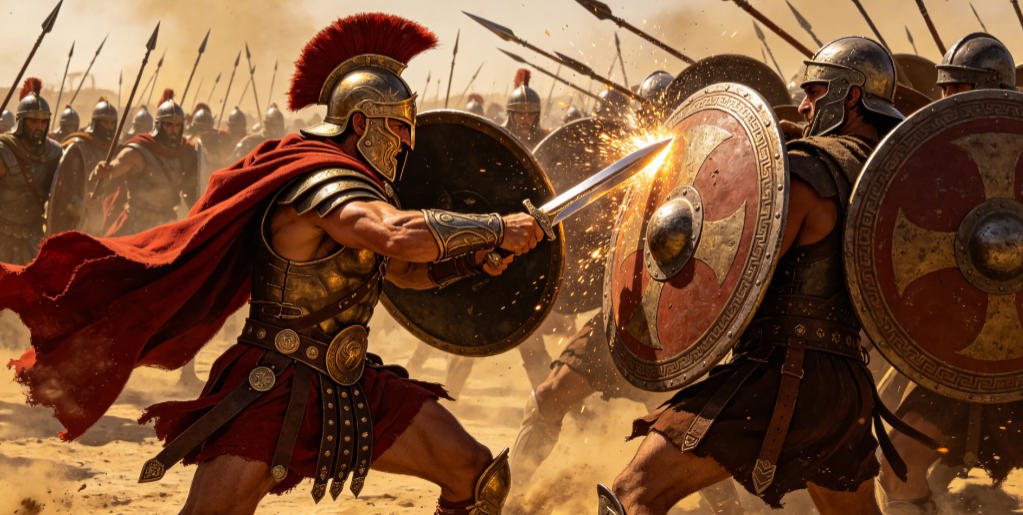
What Is a Xiphos Sword and Why Did Spartan Warriors Use It?
When people imagine the warriors of ancient Greece, images of Spartan soldiers carrying shields, spears, helmets, and short swords often come to mind. Among these famous ancient Greek weapons, the xiphos sword is one of the most recognizable.
The xiphos was a straight, double-edged Greek short sword carried as a secondary weapon by many Greek warriors. It was especially associated with the Hoplite military system, where soldiers primarily relied on the long dory spear and large shield before turning to the sword when fighting became closer.
Although compact compared with many later European swords, the xiphos was carefully suited to close-quarters combat. Its relatively short blade could be maneuvered in crowded formations, making it an important part of the equipment carried by Greek infantry.
The weapon is also strongly associated with Spartan warriors, whose unusually short swords became an enduring symbol of Spartan military culture.
From xiphos sword meaning and ancient Greek sword history to its blade design, Hoplite warfare, Spartan connections, and modern collecting, the xiphos offers a fascinating look at how weapons were designed around the battlefield systems of their time.
1. What Is a Xiphos Sword?
The xiphos sword was a one-handed, straight, double-edged sword used in the ancient Greek world. It generally functioned as a secondary weapon rather than the primary weapon of a Hoplite.
The basic xiphos sword meaning is therefore quite simple: it was an ancient Greek short sword designed for close combat.
However, describing the xiphos only as a “short sword” misses its importance within Greek warfare.
A typical xiphos featured:
- A relatively short straight blade
- Two sharpened edges
- A pointed tip
- A compact hilt
- A blade suitable for cutting and thrusting
- A form that could be used effectively alongside a shield
Many surviving and reconstructed examples have broad or leaf-shaped blades, although historical examples were not completely standardized.
The exact dimensions and blade profiles could vary by period and region. Some examples were longer, while swords associated with Spartan warriors are often described as particularly short.
This variation is important when studying Greek sword history, because there was not one universal xiphos pattern used by every Greek soldier.

2. What Does Xiphos Mean?
The word xiphos comes from Ancient Greek and means “sword.” The term appears in ancient Greek literary traditions and is now commonly used by historians and collectors to describe the characteristic straight, double-edged Greek sword.
In modern searches, xiphos sword meaning usually refers to the ancient Greek short sword associated with Hoplite soldiers.
It is useful to distinguish the xiphos from other famous Greek weapons:
- Xiphos — straight, double-edged short sword
- Kopis — curved, generally single-edged cutting sword
- Makhaira — a broader category of single-edged blade
- Dory — the long spear used by Greek Hoplites
- Hoplon/Aspis — the large shield associated with Hoplite warfare
These weapons were not interchangeable. Each had a different role within ancient Greek combat.
The xiphos therefore represents more than a particular blade shape. It reflects the close relationship between weapon design and military tactics in ancient Greece.
3. Xiphos Sword History: From Bronze Age to Classical Greece
The history of the xiphos reaches back into the broader development of Greek and European sword traditions.
Before iron became dominant, Bronze Age warriors in the Aegean world used bronze swords of various forms. Later developments in metallurgy and changes in warfare gradually encouraged the adoption of iron weapons.
The xiphos belongs to this larger transition from Bronze Age sword traditions to Iron Age Greek weapon systems.
Rather than appearing suddenly as a completely new invention, the familiar Greek short sword developed through earlier blade traditions and changing military requirements.
By the Archaic and Classical periods, the xiphos had become an important secondary weapon for Greek infantry.
During conflicts involving Greek city-states, including the Persian Wars and Peloponnesian War, Hoplite warfare relied heavily on disciplined infantry formations. The spear was normally the principal offensive weapon, while the sword provided an additional option when the spear became unusable or when combat moved into very close quarters.
This explains why the xiphos was generally not designed around maximum reach.
Its purpose was different.
It needed to remain useful when soldiers were standing close together, shields were overlapping, and there was little room for large movements.
4. Why Did Greek Hoplites Carry a Xiphos?
To understand the Hoplite sword, it is necessary to understand the Hoplite itself.
A typical Greek Hoplite carried a combination of weapons and protective equipment, including:
- Large round shield
- Long dory spear
- Helmet
- Body armor
- Greaves
- Secondary sword
The spear was generally the primary offensive weapon.
The large shield protected the warrior while also contributing to the cohesion of the formation.
But battle conditions could change quickly.
A spear might break, become lost, become entangled, or simply become difficult to use when opposing formations collided.
When that happened, the xiphos provided a compact secondary weapon.
Its relatively short length made it easier to control around shields and other soldiers. In the dense environment of phalanx warfare, this was an important advantage.
The xiphos was therefore not necessarily the weapon a Hoplite wanted to begin the battle with. It was part of a layered weapon system in which the spear, shield, armor, and sword all had different functions.
5. Was the Xiphos the Spartan Sword?
The xiphos is strongly associated with Sparta, but calling it exclusively a “Spartan sword” would be misleading.
Spartan warriors were Hoplites, and their primary battlefield weapon was the spear rather than the sword.
However, historical descriptions and surviving evidence have led to a strong association between Sparta and particularly short xiphos blades.
Some Spartan-associated examples are described as having blades around 30–45 cm, considerably shorter than the roughly 60 cm blades often associated with the broader xiphos tradition. Such a compact weapon would have been especially practical when fighting within the crowded space of a Hoplite formation.
This short Spartan sword became an important part of the popular image of Spartan warriors.
Modern films, games, books, and historical illustrations often emphasize the combination of:
Spartan warrior + spear + shield + short xiphos sword
This imagery has helped make the xiphos one of the most recognizable ancient Greek swords in modern culture.
6. Xiphos Sword Design and Blade Shape
One of the most distinctive characteristics of the xiphos is its blade design.
Many examples feature a broad, leaf-shaped profile that narrows toward the tip. This shape provides a balance between cutting ability and thrusting capability.
Double-Edged Blade
The xiphos normally featured two sharpened edges.
This allowed the warrior to use either edge during close combat and made the sword versatile for different types of movement.
Pointed Tip
The pointed end allowed the weapon to perform thrusting attacks in addition to cutting.
Compact Blade
The relatively short blade made the weapon easier to maneuver in crowded formations.
Central Ridge
Some xiphos blades featured a central ridge or reinforced section that helped provide rigidity.
The exact construction varied across historical examples, so it is better to think of the xiphos as a family of related ancient Greek short swords rather than one perfectly standardized design.
This variation is one of the most interesting aspects of ancient Greek weapon history.
7. How Was the Xiphos Used in Ancient Greek Warfare?
The battlefield role of the xiphos was closely connected with the limitations of spear-and-shield combat.
A Hoplite formation depended on cohesion.
When soldiers were standing close together, there was limited space for wide sword swings. A long sword could become difficult to maneuver, especially when shields and fellow soldiers surrounded the warrior.
The shorter xiphos could remain useful in these conditions.
Historical descriptions generally place the sword in a secondary role, particularly when the spear had been lost or broken or when the formation had broken down into closer combat.
The xiphos could therefore serve several battlefield functions:
- Close-range combat
- Emergency weapon after spear failure
- Fighting around shields
- Thrusting and cutting
- Combat during formation breakdown
- Secondary defense
This tactical role explains why the xiphos became such an effective part of the Greek Hoplite weapon system.
8. Xiphos vs Kopis: What Is the Difference?
When researching ancient Greek swords, two names appear repeatedly: xiphos and kopis.
Although both were used in ancient Greece, their designs were very different.
Xiphos Sword
The xiphos generally has:
- Straight blade
- Double edges
- Compact proportions
- Pointed tip
- Cutting and thrusting capability
- Strong association with Hoplite infantry
Kopis Sword
The kopis generally features:
- Curved blade
- Single cutting edge
- Forward-weighted design
- Strong cutting orientation
- Distinctive hooked or recurved appearance in some examples
The xiphos and kopis demonstrate two different approaches to ancient sword design.
The xiphos emphasizes a relatively compact, versatile blade, while the kopis places greater emphasis on powerful cutting.
Neither should simply be described as the “better” Greek sword. They developed for different contexts and tactical requirements.

9. Xiphos vs Roman Gladius
The Roman gladius is another ancient short sword that is frequently compared with the xiphos.
Both are compact weapons associated with infantry warfare, but they belong to different military cultures and historical periods.
The xiphos developed within ancient Greek weapon traditions, while the gladius became strongly associated with Roman military forces.
Both could be used for thrusting and cutting, but their blade shapes, construction, military contexts, and historical development were different.
The comparison is nevertheless useful because it demonstrates how different ancient civilizations developed compact swords for infantry combat.
The xiphos is particularly important when studying the evolution of the ancient Greek short sword and the broader history of European military blades.
10. Materials and Forging of the Xiphos
Early Greek sword traditions included bronze weapons, while later Greek swords were increasingly made from iron as ironworking became more widespread.
This transition was part of the broader development of Iron Age weapons throughout the Mediterranean and Europe.
Iron offered important advantages for sword production, but ancient metallurgy was very different from modern steelmaking.
Modern Greek sword replicas therefore use materials and manufacturing techniques that can differ considerably from historical examples.
Collectors may encounter modern reproductions described as:
- Hand forged Greek xiphos sword
- High carbon steel Greek sword replica
- Spartan sword replica
- Ancient Greek short sword replica
- Historical Greek weapon reproduction
- Damascus xiphos-style sword
These modern designs are generally created for historical display, collecting, reenactment, or decorative purposes rather than as exact archaeological reproductions.
For collectors interested in authenticity, blade proportions, hilt construction, scabbard design, and historical period should all be considered—not just the material used for the blade.
11. Xiphos Sword in Modern Culture
The popularity of ancient Greek history has kept the xiphos visible long after the ancient world disappeared.
Today, the weapon appears in:
- Historical documentaries
- Ancient Greek museums
- Spartan-themed films
- Video games
- Historical reenactments
- Educational displays
- Greek mythology collections
- Fantasy artwork
- Sword collecting communities
The popularity of Spartan culture has been particularly important.
The image of a Spartan warrior carrying a shield, spear, and short sword has become a global symbol of ancient Greek military culture.
This has also created interest in xiphos sword replicas, Spartan sword replicas, and other ancient Greek weapon reproductions among modern collectors.
12. Why Is the Xiphos Sword Still Popular Today?
Several characteristics explain the continuing popularity of the xiphos.
Strong Spartan Connection
The weapon is closely connected with the popular image of Spartan warriors.
Distinctive Design
Its leaf-shaped or compact double-edged blade is instantly recognizable.
Historical Importance
The xiphos provides insight into how Greek Hoplites actually organized their weapons around the phalanx.
Ancient Greek Heritage
It represents an important chapter in the history of Mediterranean weapons.
Modern Collecting
Historical sword enthusiasts can find a wide range of Greek sword replicas inspired by ancient designs.
The xiphos therefore occupies an interesting position between archaeology, military history, popular culture, and modern collecting.
Conclusion: The Xiphos Sword and the Legacy of Ancient Greek Warriors
From xiphos sword meaning to Spartan warfare, the xiphos is much more than an ancient short sword.
It was an important component of the Greek Hoplite's equipment, working alongside the dory spear and large shield as part of a coordinated battlefield system. Its compact size, double-edged blade, and practical design made it particularly useful when combat moved into close quarters.
The connection between the xiphos sword and Spartan warriors has also given the weapon a powerful cultural legacy. Today, the ancient Greek short sword remains familiar through museums, historical research, films, games, reenactments, and collectible replicas.
For anyone interested in ancient Greek weapons, Spartan sword history, Greek Hoplite warfare, historical sword replicas, or the evolution of European swords, the xiphos provides an excellent example of how a weapon can be shaped by the battlefield around it.
Its story is ultimately a story of practical design: a compact blade created for an army whose strength depended on discipline, formation, shield, spear, and the ability to keep fighting when the first weapon was no longer enough.
